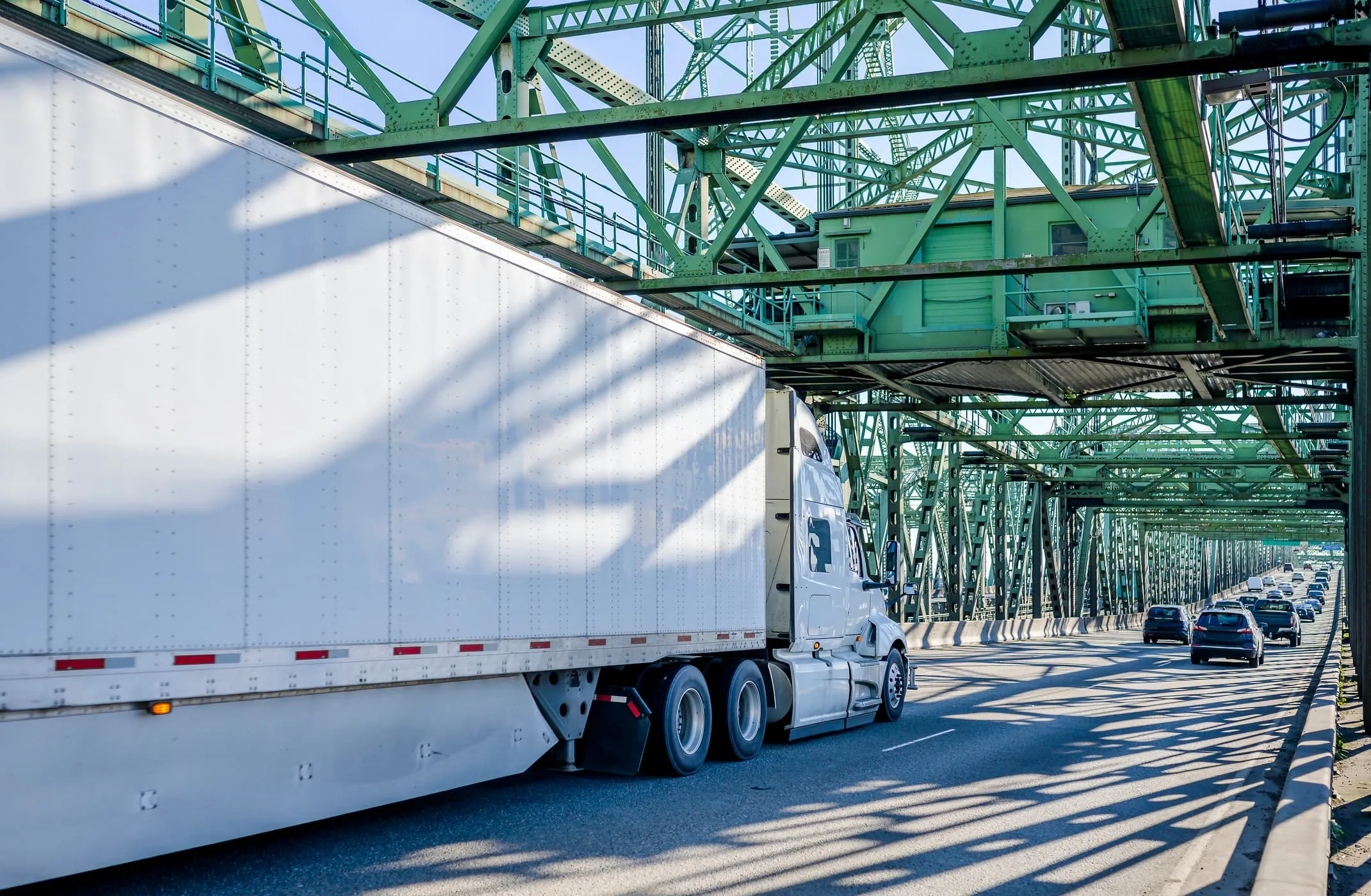
Imagine you are driving home on a familiar stretch of local highway when a massive 18-wheeler suddenly swerves into your lane. The collision is violent, your car is totaled, and you are left dealing with severe injuries, mounting medical bills, and lost wages. As you sit in the emergency room, you look at the crash report and notice something that triggers a wave of panic: the trucking company is headquartered thousands of miles away in another state, and the driver holds an out-of-state license.
If you’re asking yourself, “can I still file a claim if the trucking company is out-of-state,” the short answer is yes.
Does this geographic distance mean you are out of luck? Can an out-of-state corporation simply retreat behind state lines to avoid taking responsibility for the harm they caused you? The answer, unequivocally, is no — you absolutely have the right to seek compensation, but cross-state commercial vehicle crashes are treated differently than typical personal injury cases and introduce unique legal hurdles that require a clear strategy to navigate successfully.
Yes, You Can Still File a Claim Against an Out-of-State Trucking Company
You do not lose your legal rights simply because a commercial truck crossed a state line before crashing into your vehicle. The U.S. legal system is designed to hold interstate commerce accountable when damage is caused. Because interstate carriers profit from shipping goods across the country, federal and state laws explicitly prevent them from hiding behind geographic borders when their drivers cause harm.
A motor carrier operating out of Texas, Ohio, or California is still subject to legal action if their vehicle collides with you, and you retain the right to pursue full compensation. However, holding an out-of-state defendant accountable requires understanding how state courts gain legal authority over people and businesses located hundreds or thousands of miles away.
Understanding Jurisdiction in Cross-State Truck Accident Claims
To successfully sue any person or business, the court handling your case must have “jurisdiction,” meaning the official power to make legal decisions and judgments over the parties involved. Two foundational legal concepts determine where and how you can hold the negligent parties accountable in a cross-state case:
- Personal Jurisdiction: The court has authority over out-of-state entities.
- Long-Arm Statute: Extends state power to out-of-state defendants.
Both factors help determine the best venue: the state where the crash occurred (most common), or the state where the trucker or company resides.
What Is “Personal Jurisdiction”?
Personal jurisdiction refers to a court’s authority over a specific defendant. A court in your home state cannot simply order a person living in another state to pay damages unless that person or business has established meaningful connections with your state.
In legal terms, these connections are called “minimum contacts.” When an out-of-state trucking company sends its fleet onto your local highways to haul freight, generate revenue, and deliver goods, it deliberately establishes these minimum contacts. By choosing to conduct business within your state’s borders, the company voluntarily submits to the legal authority of your state’s court system for any harm that occurs while operating there.
The Long-Arm Statute Explained
How does a local court actually reach across state lines to pull an out-of-state corporation into a personal injury lawsuit? The legal mechanism used is called a “long-arm statute.”
Every state has its own version of a long-arm statute. Think of it as a legal lasso that allows local courts to exercise authority over out-of-state defendants, provided those defendants have committed specific acts within the state. Because causing a motor vehicle collision and inflicting bodily injury inside a state’s borders is a clear triggering event under every long-arm statute in the country, your local courts can legally summon the out-of-state driver and their employer to respond to your lawsuit.
Where Should You File Your Lawsuit? What a Truck Accident Lawyer Considers
When an interstate truck crash occurs, you generally have a choice regarding where to file your injury lawsuit, but one venue is usually superior.
- Where the accident occurred: This is almost always the most favorable and convenient venue. The local courts have automatic authority over the event, the investigating police officers and medical responders are located nearby, and the physical evidence is easily accessible.
- Where the trucking company is headquartered: You have the legal right to file a lawsuit in the company’s home state, as that court also has jurisdiction over it. However, pursuing a case far from home introduces major travel expenses and forces you to fight on the defendant’s home turf.
- Where the truck driver resides: If the driver lives in a third state separate from both you and the trucking company’s headquarters, that state’s courts would also have authority over the driver individually.
For the vast majority of injury victims, filing in the court district where the crash took place provides the strongest tactical advantage, which is one reason a truck accident lawyer will often push to keep the case local whenever possible.
Why Out-of-State Truck Accident Cases Are More Complex
While you clearly have the right to sue an out-of-state motor carrier, doing so is rarely as straightforward as resolving a standard car accident claim between two local drivers. Interstate commerce introduces overlapping layers of law, multiple corporate entities, and massive commercial insurance policies designed to defeat or minimize high-value claims. Commercial truck accidents involving carriers based in another state carry a distinct set of legal and procedural challenges that a same-state crash simply doesn’t.
Federal vs. State Trucking Regulations
Commercial trucking is governed by a dual regulatory system. At the national level, the Federal Motor Carrier Safety Administration (FMCSA) sets strict rules covering everything from driver qualification standards and mandatory rest breaks to maximum vehicle weight limits and equipment maintenance schedules.
Simultaneously, the state where the crash occurred enforces its own motor vehicle statutes, traffic laws, and civil tort rules. Building a successful claim requires demonstrating how the out-of-state driver or company violated specific federal safety regulations such as hours-of-service rules or vehicle maintenance standards, and how those violations directly caused the local crash under state law.
Dealing with Multiple Potentially Liable Parties
In a standard auto crash, you typically deal with one driver and one insurance carrier. In a commercial freight collision, a web of interconnected entities may share legal responsibility for your injuries:
The Truck Driver: for direct operational negligence like speeding, distracted driving, or driving under the influence
The Motor Carrier (Trucking Company): when employees commit negligent acts while doing their jobs, employers are liable under the legal doctrine of respondeat superior (let the master answer), also known as vicarious liability; they can also be sued directly for negligent hiring, improper training, or forcing drivers to violate safety rules
Freight Shippers and Cargo Loaders: if an out-of-state shipping company improperly balanced, overfilled, or failed to secure the truck’s cargo, causing the vehicle to jackknife or roll over
Third-Party Maintenance Providers: independent mechanics responsible for inspecting or repairing critical components like brakes and tires who failed to spot dangerous defects
Unraveling this corporate web across state lines, including whether the driver was an employee or an independent contractor, requires deep legal discovery to determine which entities hold financial responsibility.
Navigating Complex Insurance Policy Limits
Because commercial big rigs can cause catastrophic damage, federal law mandates that motor carriers carry far higher insurance coverage than standard passenger vehicles. While a private driver might carry $25,000 or $50,000 in liability limits, an interstate commercial truck must carry anywhere from $750,000 to upwards of $5,000,000 in primary coverage, depending on the nature of the cargo being hauled.
When millions of dollars are on the line, insurance companies do not simply write checks. They assign elite claims adjusters and corporate defense attorneys whose sole job is to protect their bottom line. These teams will scrutinize your medical history and police reports, attempt to shift blame onto you, and exploit geographic distances to delay proceedings in hopes that you will accept a lowball settlement out of financial desperation.
Key Steps to Take After an Accident with an Interstate Trucker
The decisions you make in the hours, days, and weeks following an interstate truck collision will directly shape your ability to recover full financial compensation. Because the defendant is based out of state, taking proactive steps early helps ensure vital evidence does not disappear across state borders.
1. Gather Immediate Evidence at the Scene
If you are physically able to do so safely, capture as much visual and written evidence as possible before the scene is cleared:
- Photograph the physical damage to all vehicles from multiple angles, skid marks, road conditions, traffic signs, visible bodily injuries, and any other property damage.
- Photograph the commercial truck’s license plate, trailer numbers, DOT registration number displayed on the cab door, and any corporate branding.
- Obtain the driver’s full legal name, commercial driver’s license (CDL) number, state of issuance, and the exact corporate name and contact information of their employer.
- Collect names and phone numbers of any independent eyewitnesses who saw the crash occur.
2. Seek Prompt Medical Evaluation and Documentation
Even if you believe your injuries are minor, visit an emergency room or urgent care clinic immediately. High-impact crashes often inflict soft tissue trauma, internal bleeding, or traumatic brain injuries that do not display severe symptoms until hours or days later.
Furthermore, insurance adjusters look for any gap between the date of the crash and your first medical treatment. Seeking immediate care establishes an indisputable link between the interstate truck crash and your physical injuries, and it creates the documented medical bills you’ll need to support your claim later.
3. Avoid Giving Recorded Statements to Insurance Adjusters
Within days of the crash, a representative from the trucking company’s insurance carrier will likely call you. They may sound exceptionally friendly, empathetic, and eager to “take care of your expenses.”
Do not be fooled. They are seeking a recorded statement that can be parsed, misconstrued, and used against you later to undermine your claim. Kindly refuse to give any written or recorded statement, and do not sign any medical release forms or settlement offers until you have consulted with a legal professional or spoken with a personal injury lawyer.
4. Act Quickly to Prevent Evidence Spoliation
Unlike personal automobiles, modern commercial semi-trucks are rolling data centers. They contain complex electronic systems that hold the key to proving fault, including:
- Event Data Recorders (EDRs): the truck’s “black box,” which logs vehicle speed, brake application, engine RPMs, and steering movements immediately prior to impact
- Electronic Logging Devices (ELDs): digital systems tracking driver hours to ensure compliance with federal rest rules
- Dashcam Footage: forward-facing and cab-facing video recordings
Here is the critical catch: trucking companies are legally permitted under federal rules to overwrite or destroy much of this onboard data after a set period, sometimes as short as 30 days, unless they are formally notified to preserve it. Sending a legal document called a “spoliation letter” demands that the motor carrier immediately freeze and retain all physical, digital, and maintenance records related to the crash.
How Federal Regulations Protect Your Right to Recovery
When you are involved in a crash with an out-of-state semi-truck, federal law acts as a powerful shield for your rights. The Federal Motor Carrier Safety Administration establishes strict nationwide standards, ensuring that trucking companies cannot claim ignorance of local laws or evade accountability simply because they operate across state lines.
Federal safety protections break down into three key areas:
- Rest & Hours: Hours-of-Service limits, tracked by Electronic Logging Devices (ELDs)
- Tech & Data: black box (EDR) and dashcam data
- Mandatory Insurance: financial caps ranging from $750,000 to $5 million+
FMCSA Safety Requirements
Federal regulators strictly govern commercial driving operations to keep the public safe. Among the most critical rules are the Hours-of-Service (HOS) regulations, which limit drivers to a maximum of 11 hours of driving time within a 14-hour window after taking 10 consecutive hours off duty.
When out-of-state companies force their drivers to meet unrealistic delivery deadlines, truckers may drive exhausted or manipulate logs. Proving an HOS violation is often the smoking gun that establishes clear liability against both the driver and the motor carrier.
Mandatory Electronic Logging Devices (ELD) and Black Box Data
To eliminate manual log falsification, federal law requires almost all interstate commercial motor vehicles to use certified ELDs. These devices connect directly to the engine to automatically record driving time, engine hours, vehicle movement, and location, replacing the paper driver logs trucking companies once relied on.
Combined with the truck’s onboard Event Data Recorder (EDR), this electronic evidence provides an unbiased, second-by-second breakdown of exactly what the driver was doing right before the crash occurred.
Required Minimum Liability Insurance Coverage
Federal law ensures that when an out-of-state commercial vehicle causes severe injuries, there are sufficient financial resources available to pay for the damages. Title 49 of the Code of Federal Regulations mandates minimum liability coverage tiers based on the type of freight being transported:
- $750,000 minimum for non-hazardous freight moved in vehicles over 10,000 pounds
- $1,000,000 minimum for oil and certain heavy hazardous materials
- $5,000,000 minimum for explosives, dangerous radioactive materials, or toxic bulk cargo
These high mandatory minimums help guarantee that victims of catastrophic crashes, especially those caused by carriers with poor safety records, are not left financially ruined by unpaid medical debts.
Challenges You Might Face (and How to Overcome Them)
Pursuing a claim across state lines introduces procedural maneuvers and legal defenses that rarely appear in local traffic court disputes. Being prepared for these obstacles is the best way to keep your claim moving forward smoothly.
Out-of-State Service of Process Delays
Before a lawsuit can officially begin, the formal legal paperwork, known as the summons and complaint, must be physically delivered to the defendants. This procedure is called “service of process.”
Serving an out-of-state trucking company or a driver who lives across the country can be logistically challenging. If the company operates in a distant state, process servers must locate its registered agent or corporate officers to complete service in full compliance with both states’ legal requirements. Any procedural mistake can cause lengthy court delays or force a judge to dismiss your suit on technical grounds.
Attempts to Move the Case to Federal Court (Diversity Jurisdiction)
If you file your lawsuit in your state court, the out-of-state corporate defense team will frequently try to remove the case to federal district court using a legal concept known as ”diversity jurisdiction.”
Federal courts have jurisdiction over civil cases in which the financial damages claimed exceed $75,000, and the plaintiff (you) and the defendants (the trucker and company) live in different states. Defense lawyers often prefer federal court because the procedural rules are highly formal, deadlines are rigid, and jury selection draws from a wider, often more conservative geographical area. An experienced truck accident attorney familiar with federal civil procedure can effectively counter these tactics.
Conflicting State Laws and Comparative Fault Rules
When a crash involves parties from different states, courts must determine which state’s liability laws govern the dispute. This process, known as “choice of law,” can dramatically impact your final compensation.
For instance, states follow different rules regarding legal fault:
- Modified Comparative Fault: Used by the majority of states. You can recover damages as long as you were less than 50% (or 51%, depending on the state) at fault for the crash, though your compensation is reduced by your percentage of fault.
- Pure Comparative Fault: You can recover damages even if you were 99% at fault, though your payout is reduced proportionally.
- Contributory Negligence: Followed by a small minority of jurisdictions. If you are found even 1% at fault for the accident, you are completely barred from recovering any financial compensation.
Navigating these conflicting legal doctrines requires a precise understanding of cross-jurisdictional tort law.
How an Experienced Personal Injury Attorney Helps
Fighting a multi-million-dollar out-of-state corporate entity on your own is an uphill battle. A skilled personal injury attorney specializing in commercial vehicle crashes serves as your advocate, leveling the playing field in several key ways:
- Immediate Investigation and Preservation: Your lawyer will draft and send legal spoliation demands to lock down black box data, ELD records, dashcam video, and driver qualification files before they are erased.
- Navigating Complex Jurisdiction: An experienced attorney knows how to use long-arm statutes correctly, properly serve out-of-state defendants, and choose the most favorable state or federal court venue for your case.
- Uncovering All Sources of Recovery: By analyzing freight contracts, bills of lading, and corporate structures, your legal team can identify every liable party, from the parent shipping company down to the cargo loader.
- Hiring Industry Experts: High-stakes trucking litigation often requires expert testimony. Your attorney can bring in accident reconstructionists, commercial vehicle safety experts, and medical planners to calculate the lifelong cost of your injuries.
- Handling Aggressive Defense Tactics: A dedicated advocate protects you from lowball settlement offers and manipulative tactics, managing all negotiations while preparing your case for trial if the insurer refuses to make a fair offer. Most firms offer a free consultation, so there is little cost to having your case reviewed early.
Frequently Asked Questions About Out-of-State Truck Claims
Can I still file a claim if the trucking company is out-of-state?
Yes. Crossing a state line does not shield a trucking company from liability. Under long-arm statutes, the state where the crash occurred typically has personal jurisdiction over the out-of-state driver and motor carrier, so you can file locally rather than traveling to the company’s home state. Federal insurance minimums and safety regulations still apply regardless of where the carrier is headquartered, meaning your right to full compensation is not affected by geography.
What if the accident happened in my home state, but the trucker lives elsewhere?
You are in a strong legal position. Under state long-arm statutes, the state court where the crash took place has clear personal jurisdiction over any non-resident driver or out-of-state trucking company involved in a local collision. Filing your claim in your home state allows you to handle legal proceedings, medical care, and court appearances locally, forcing the out-of-state defendants to come to you.
How long do I have to file a claim against an out-of-state trucking company?
Every state has a strict deadline called the statute of limitations that dictates how long you have to file an injury lawsuit after a crash. Depending on the state where the accident occurred, this window typically ranges from one to three years from the date of the collision.
Because interstate cases require extra time to investigate corporate ownership, secure out-of-state electronic evidence, and navigate service of process, it is vital to contact a lawyer as soon as possible. Waiting too long can permanently prevent you from seeking compensation.
Do I need to hire a lawyer located in the state where the trucking company is headquartered?
No. In fact, it is almost always far better to hire an experienced injury lawyer located in the state where the crash occurred. Local attorneys understand the local court rules, know the judges and legal community, and can easily visit the crash scene and coordinate with local medical providers. If your attorney needs to handle proceedings in another jurisdiction, they can work with co-counsel in that state to manage out-of-state procedural needs.
Protecting Your Rights: When to Call a Truck Accident Attorney
Being hit by a massive commercial truck is a traumatizing, life-altering experience. Finding out that the motor carrier is headquartered hundreds of miles away in another state can leave you feeling powerless, but the law gives you clear avenues to pursue justice.
Geography does not shield negligent commercial trucking companies from accountability. By taking swift action, preserving critical digital evidence, and seeking knowledgeable legal counsel, you can assert your legal rights, hold the out-of-state driver and corporate entities responsible, and secure the full financial recovery you need to rebuild your life, including compensation for pain and suffering and emotional distress.